

Alex Chalkias
1 March 2022
Containerisation has transformed the enterprise IT landscape, driving faster, more secure, and more predictable software delivery than ever before. Thanks to technologies like Docker, building containerised applications is easy, and many businesses are working with hundreds or even thousands of containers.
To effectively deploy and manage all of these microservices, a container orchestration tool is essential, and Kubernetes is the leading solution. Kubernetes provides a unified way to organise deployment and lifecycle management of containers across infrastructures, while also delivering invaluable automation, scalability, and self-healing capabilities.
Naturally, the containerisation trend has extended to IBM Z and LinuxONE users. Given the unrivalled performance, reliability, and security of IBM’s enterprise servers, many businesses rely on them for mission-critical workloads, and they are perfect platforms for modern microservices that demand highly resilient infrastructure.
However, implementing and managing Kubernetes often involves considerable manual work, requiring a dedicated DevOps or platform engineering team and rendering container strategies time-consuming, expensive, and impractical.
This is where MicroK8s comes in.
Deploy Kubernetes anywhere in under a minute
MicroK8s is a lightweight, zero-ops, and fully-conformant distribution of Kubernetes that cuts out the complexity of deployment and management. With MicroK8s, all Kubernetes services are packaged into one artefact that can be deployed with a single command in under a minute.
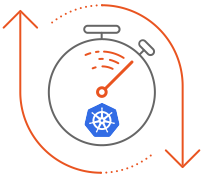
MicroK8s can run anywhere: local workstations, public clouds, edge, IoT devices, and data centres – including on IBM Z and LinuxONE. And regardless of the platform, MicroK8s only ever takes a single command to deploy and very few commands to cluster, making day-long Kubernetes infrastructure setup efforts a thing of the past.
Zero-ops infrastructure
Whereas Kubernetes typically requires extensive manual configuration and management, MicroK8s comes preconfigured with the most widely used settings so that it works seamlessly straight out of the box. Additionally, cluster lifecycle operations such as installing auxiliary services and data store maintenance are streamlined, and security patching is fully automated by default.
Using MicroK8s, companies can do anything that would be possible on vanilla Kubernetes, without being weighed down by unnecessary features and housekeeping. This minimal-ops approach drastically improves the resource and cost-efficiency of Kubernetes, eliminating the need for dedicated maintenance teams.
Production and testing on the same system
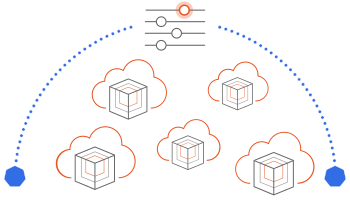
Given its ease of deployment and low ops nature, MicroK8s not only serves the needs of a production environment, it also enables developers to effortlessly set up their own testing environment within their sandbox. What’s more, thanks to IBM Z’s isolation capabilities and workload sharing, this can all be achieved on a single, central system to maximise resource utilisation and infrastructure ROI.
Zero license fees
IBM Z and LinuxONE users can deploy MicroK8s for free and benefit from free security updates with no licensing required. The only cost associated with MicroK8s is optional 24/7 enterprise support from Canonical.
Combining IBM Z, MicroK8s, and Ubuntu
MicroK8s can be deployed on major Linux flavors, Windows and macOS, and it is right at home on Ubuntu, since both are developed and maintained by Canonical. Furthermore, Ubuntu is the leading operating system for Kubernetes deployments worldwide, and Ubuntu Server is one of the most popular choices among IBM Z and LinuxONE users.
The synergy between these three technologies makes MicroK8s especially powerful on IBM Z and LinuxONE. Combining the unparalleled capabilities of IBM’s servers with the familiarity of Ubuntu and the ease of use of MicroK8s leads to an immensely reliable, scalable, and cost-effective environment for mission-critical containerised applications.
MicroK8s offers the clearest path to value for Kubernetes on IBM Z and LinuxONE. To learn more, you can watch the “MicroK8s on IBM Z” technical session or contact us today.


